
The
Cloud Mound
Reimagining Kilburn’s Gaumont State Theatre through storytelling, adaptive reuse, and sustainable futures
by Diego Grisaleña Albéniz
This paper explores The Cloud Mound, a speculative, playful, and utopian proposal for the future of the Gaumont State Theatre in Kilburn, London. Once a cinema, concert hall, bingo hall, and church, this 1930s landmark [1] is reimagined as a public space and contemporary pilgrimage site celebrating Kilburn’s rich multicultural heritage. The project is the outcome of a prior research investigation into the theatre’s historical transformations and the neighbourhood’s evolution, developed through storytelling and a pop-up book-device inspired by Cortázar’s Hopscotch [2] and folding paper dollhouses [3] . The proposal envisions an artificial mound atop the theatre, integrating a sustainable, collective data archive using the existing Project Silica’s [4] quartz-glass technology—offering free, low-impact cloud storage to residents. By combining architecture, technology, and community memory, The Cloud Mound imagines a democratic, digital commons that addresses environmental and social challenges while reinforcing Kilburn’s identity as a diverse, welcoming community.
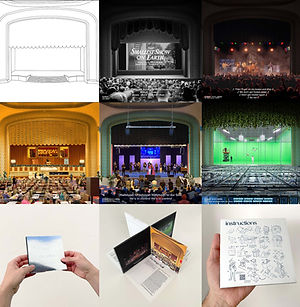
[Image 1]
The pop-up book device presents seven “acts” unfolding within the same spatial frame: the main auditorium of the Gaumont State Theatre. Six of these acts are included in this image, starting from the top left corner: the temple, the cinema, the concert venue, the bingo hall, the worship space, and the data centre.
Each act is represented through a digital collage using the same base perspective - looking towards the main stage of the auditorium. All scenes are grounded in the building‘s past or present uses, with the exception of the data centre, which proposes speculative futures within the bounds of the Gaumont State Cinema.
-The Temple: A blank canvas inviting the viewer to reimagine the use of the main auditorium, drawing on its historic associations with ritual, worship, and escapism.
-The Cinema (1937–1960): Operated by the Gaumont cinema chain, this scene shows the 1957 film The Smallest Show on Earth, a story about a tiny cinema filmed in Kilburn.
-The Concert Venue: Depicts a 1977 performance by The Who, reflecting the building‘s time as a major music venue.
-The Bingo Hall (1980–2007): Operated by the Mecca Bingo company during this period.
-The Worship Space: Since 2007, the auditorium has been owned by Ruach City Church, a non-denominational Pentecostal Christian congregation. The collage depicts a typical Sunday service, which can be attended both in person and online.
-The Data Centre: A speculative, dystopian future set in the aftermath of climate collapse and a global data storage crisis. Here, the fictional company “Heaven” becomes a sustainable data storage provider using plants and forests as organic servers - “more data, less CO₂.” This concept eventually inspired the more optimistic and realistic Cloud Mound proposal.
Image by the author (2022–2023).

[Image 2] The cloud-made mound covering and protecting the existing main auditorium.
Image by the author (2023).

[Image 3] The cloud-made mound, capturing the beauty of a private and intimate moment with a virtual assistant in one of the memory booths.
Image by the author (2023).

[Image 4] Email header: Welcome to Cloud Mound / Invitation. Image based on the layout of the Gmail web application interface.
Image by the author (2023).

[Image 6] The cloud-made mound covering and protecting the existing main auditorium.
Image by the author (2023).

[Image 5] Diagram illustrating the physical, administrative, and demographic dimensions of Kilburn, alongside the proposed United Kilburn.
Source/ Map data: Google Earth, Landsat/Copernicus.
Image by the author (2023).
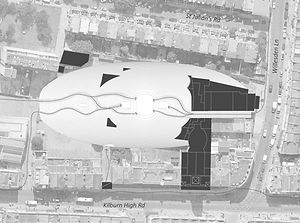
[Image 7] Roof plan of the Cloud Mound.
Image by the author (2023).

[Image 8] Floor plans of the Cloud Mound Centre.
Images by the author (2023).

[Image 9] Sequence of axonometric diagrams showing the original building, the proposed floor slabs, the megastructure, and the final artificial mound.
Images by the author (2022- 2023).
INTRODUCTION
[Image 1]
What could a windowless box capable of holding thousands of people - once a cinema, concert hall, bingo hall, and church - become in the future? Can a giant cinema, built in the 1930s, at the heart of a big city neighbourhood, still serve a purpose in the 21st century - and avoid demolition? How can we free our minds to imagine alternative futures that honour the past, engage with the present, and respond to the needs of future users - some of whom may not even be born yet?
The case of the Gaumont State Theatre in Kilburn in north London, yet still fairly central, not far from Notting Hill and Paddington to the south, or Camden Town to the east, offers a compelling example through which to explore these questions. After studying its specific and contextual history, and sparking our imaginations by reading and inventing stories, the project I present below represents one of its many possible futures: The Cloud Mound.
The speculative, playful, and utopian proposal of The Cloud Mound is the outcome of a prior project exploring the history of Kilburn and its iconic Gaumont State Theatre through a pop-up book-device, drawing on references as diverse as: Hopscotch (Rayuela) [5], the novel by Julio Cortázar that frees the reader from the conventional rules of Western novel-reading; the stage set of the play The American Mysteries [6], consisting of a cube that is unfolded or folded depending on the needs of each of the nine acts, and the old-fashioned folding paper dollhouses (with hinged paper panels designed to fold flat into a box) that began to be manufactured by McLoughlin Brothers in 1894. [7]
This book-device, with multiple readings in no particular order just like its foldings and unfoldings, contains seven different fictional stories based on reality, all sharing the same setting: the main auditorium of the Gaumont State. These stories incorporate the real and primary uses that this auditorium has had (cinema, concert hall, bingo, and church), and how, in my view, those uses share the common traits of fostering a form of worship (to entertainment, gambling, and religion) and escapism from the circumstances of their respective eras - all within an entertainment box that originally seated at least 4,004 people.
The futuristic story of The Cloud Mound imagines the continuation of the Gaumont State’s history, starting from an investigation of its past and present - its transformation from temple of entertainment to temple of worship, and how its very evolution reflects the changes in the neighbourhood it is located in, from the 1930s to today. Kilburn High Road, until not long ago known as the “Music Mile”, once boasted more than seven major cinemas and theatres [8] and was an unexpected epicentre of the music scene on the fringes of London, hosting every major band and singer one could imagine, from Frank Sinatra to The Who [9] to Adele. Today, however, it is no longer what it once was and has experienced a significant decline in its music and entertainment scene, which has been replaced, to some extent, by a resurgence of places of worship of various faiths - a reflection of its highly diverse population, with 50% of its residents born outside the United Kingdom. [10]
Large local cinemas like the Gaumont State[11], the Grange Theatre [12], or the Maida Vale Picture House [13] are currently home to the congregations of Ruach City Church (States-born church of non-denominational Pentecostal Christians), UCKG (Brazilian-based evangelical church group), and the Islamic Centre of England (Shi’a Muslim organization), respectively. A transformation not unique to Kilburn or London, but one also taking place in cinemas with similar histories and forms across England. What new uses might the future hold for these classic giant cinemas-turned-temples of different faiths?
Without further delay, here is my proposal for Kilburn’s Gaumont State Theatre: The Cloud Mound. [Image 2] [Image 6]
...Meanwhile in a memory booth...
- Good morning, what memory would you like to deposit today?
+ Hi, I have been invited to share my first memory as a newcomer to Kilburn.
- Repeat out loud the option(s), you would like for the format of your memento: audio and video, audio only, video only, 2D scan, 3D scan.
+ Audio and video please.
- I’m sorry, I didn’t understand, could you repeat your format preference for your memento?
+ A U D I O and V I D E O.
- You have chosen audio and video, is that correct?
+ YES.
- Thank you. Please remember to use Kilburn’s cloud services you agreed in advance to the terms and conditions of use of this pioneering, free, universal, public service to which all Kilburn residents are entitled. At the end of your message please choose whether you would like your memory to be accessible to other users in the Mound Archives, or whether you would prefer it to be accessible only to you or to those you have indicated. Say out loud -repeat- if you need to listen to the message again or -OK-, if you want to continue.
+ OK.
- Thank you. By default, you have 15 minutes to deposit your memory. This time can be extended by 15 minutes at a time for a total of one hour. If you wish to book a memory booth in excess of one hour, contact Mound Cloud Services in advance so that we can pre-arrange this for you. Say out loud -repeat- if you need to listen to the message again or -OK-, if you want to continue.
+ OK.
- Thank you for sharing your remembrances on our cloud. Please leave your memory after the beep.
+ (...)
[Image 3] [Image 4]
Welcome to Cloud Mound (CM)
Dear neighbour,
Welcome to United Kilburn! [Image 6]
We have been notified of your recent arrival in the ward and would like to take just 5 minutes of your time (estimated reading time) to extend a warm welcome and invite you to access the free public cloud service offered by your local authority.
We are a worldwide pioneering service offering all our residents, currently over 30,000 strong, the chance to sustainably and securely store as much information as they wish in the cloud on our Data Mound located at the iconic Gaumont State Cinema. Unlike the vast majority of data centres in existence today, our cloud consumes very few resources due to the quartz-crystal-based technology used to archive the information. This technology has been developed as part of the Silica Project [14] led by Microsoft and is part of the Optics for the Cloud Research Alliance [15], which includes the Imperial College London, Oxford University, Cambridge University and the UCL, among others.Without going into much more detail, quartz glass is a low-cost, durable WORM (write once, read many) media that is EMF-proof [16], and offers lifetimes of tens to hundreds of thousands of years with an immense storage capacity: a square glass platter the size of a DVD has a raw capacity upwards of 7TB.
With the free, universal and lifelong cloud service, we want to democratise access to new technologies for our entire population, regardless of their income or origin, breaking the monopoly of the big technology companies, and we want to contribute our grain of sand to the process of decarbonising the planet. In fact, the Cloud Mound has allowed Kilburn to meet the United Nations` Sustainable Development Goals for 2040 10 years ahead of schedule. This is no mean feat, given that the cloud is currently one of the fastest growing industries on the planet consuming large number of resources, including water, energy and a long list of materials (due to the rapid obsolescence and inability to reuse most of its components). [17] Kilburn’s Cloud Mound aims to be a paradigm shift and an example to be exported to other communities around the globe.
Our service comes with only 2 requirements. One, proving that Kilburn is your primary place of residence by providing us with valid proof of residence (rental contract, electricity, water or council tax bills, verified neighbour’s acknowledgement document...). And two, by committing to share your memories, experiences and advice with the rest of your neighbours, present and future, by attending each of the annual meetings organised for this purpose.
Kilburn is not just any place. It is one of the most diverse and multicultural neighbourhoods in the country with over 50% of its population born outside the UK and a long tradition of welcoming newcomers since the late 19th century. The Cloud Mound aims to be a place to collect, share and celebrate this diversity through the stories of their protagonists including you. That’s why we invite you to climb the Mound for the first time to deposit your first memento in the Cloud in one of the memory booths, where you can leave for generations to come who you are and what is important to you. In Kilburn every person counts, is important and together we give meaning and value to our community. Now and in the future. Welcome to Kilburn!
To book a date and time for your first visit to the mountain click on the link below:
cloudmound.kilburn.gov.uk/memorybooth/booking/date
As a final part of the welcome message, find below some brief instructions and practical information about access, circulation, functioning and history of the Cloud Mound.
Thank you for choosing to use our Cloud Service. If you have received this email in error or have not used our online service, please contact the London Ward of United Kilburn immediately. Do not reply to this email as it is not monitored. If you have any questions about your application, contact us using the details below.
Email: cloudmound-application@kilburn.gov.uk
London Ward of United Kilburn
--
Cloud Mound Centre
179 Kilburn High Road, United Kilburn, LONDON, NW6 7HY
020777210000
cloudmound@kilburn.gov.uk
A BIT OF HISTORY
In Kilburn, the seed of change (and the seed of this project) came together with a local citizen movement called United Kilburn; proudly diverse, pro-European, pro-dignity of migrants... They started discussing aspects that were relevant to the people of the area; functioning of local businesses, new job opportunities, settlement for new migrants, education… until the elephant in the room appeared in the conversation. Every fight was twice harder because of the non-practical reason of having the neighbourhood divided in two through its high street. Half of Kilburn was part of Brent, and the other half of Camden. A fictitious, administrative division that did not reflect the social reality of the neighbourhood. In its early days, United Kilburn took the fight for the reunification as its principal demand... and the rest is history.
After the UK general election in 2029 and the landslide victory of the pro-new referendum for re-entering the EU party, the government that came out promoted and supported the local platforms that helped them with the win. These platforms, including United Kilburn, were a reflection of the new municipality and localism wave happening all across the country. In Kilburn, changes took time but finally, in 2031 the reality of a single self-managed ward became true. And together with this milestone the idea of celebrating it with a project including every single person living on it - the Cloud Mound: a new sustainable public service facing the challenges of the future, providing free- access public cloud storage and a collective memory archive celebrating the diversity and multiculturality of Kilburn. A new service that multiplied the public space and facilities provided in the centre of Kilburn, offered new quality and qualified jobs and put Kilburn on the map as a global reference of the digital welfare state. A success story where local citizens, politicians, scientists and designers came and still come together in equality for the common good. [Image 5]
THE CLOUD
The Cloud is the result of a collaboration between Microsoft (through the Silica project), the British universities´ members of the Optics for the Cloud Research Alliance (Cambridge, Oxford, Southampton, UCL and the Imperial College of London), the London Ward of United Kilburn and hundreds of citizens and professionals without whose valuable help the project would not have been possible.
More information:
Microsoft Project Silica
THE MOUND
The mountain is a landform revered, celebrated, feared, loved and felt by almost every human being regardless of their origin, ethnicity or religion. Climbing a mountain can be associated with religious pilgrimage, legends, sport, leisure or the simple fact of getting to a height, looking around and taking a breath of fresh air.
Therefore, at the beginning of the project, a research period was opened to gather information on natural mounts related to all population groups in Kilburn (most numerous origins, religion, continent, collective ideology...) as well as some of the most relevant examples of man-made mounts or substitutes built or proposed in the last century [Image 7]
Access:
East Access: From Kilburn High Road.
West Access: St Julian’s Rd.
South Access: Priory Park.
North Access: Willesden Ln.
Opening hours:
Monday to Thursday 09.30 – 20.00
Friday 09.30 – 18.00
Saturday 09.30 – 21.00
Sunday 11.00 – 21.00
London Ward of United Kilburn
--
Cloud Mound Centre [Image 5]
179 Kilburn High Road, United Kilburn, LONDON, NW6 7HY
020777210000
cloudmound@kilburn.gov.uk
[Image 9]
SYNOPSIS
Site:
Gaumont State Cinema, currently owned and used by Ruach City Church (2025).
Programme brief:
An artificial mound that works as a public space, a permanent outdoor grandstand and a contemporary pilgrimage spot that celebrates the historic tradition of diversity and multiculturality in Kilburn, London. The mound protects and opens to the public a collective and social long-term and sustainable data storage and an archive based on the project silica technology that uses quartz glass as storage media. The mound is placed literally on top of the Gaumont State Cinema’s main auditorium to protect, regenerate and reclaim it as a current and future monument of the neighbourhood and to generate synergies between current and proposed uses.
Schedule of accommodation:
The Cloud: Memory Booths, Data Archives, Data consultation, Entrance Hall, general storage and maintenance spaces, public toilets, and connection spaces between the cloud and the existing cinema.
The Mound: outdoor grandstand, meadows, tap water, the cave, outdoor cinema walking paths (stairs).
Design development:
It is a project that could happen tomorrow, a prototype, a futuristic proposal based, however, on technologies, needs and users already existing.
EPILOGUE
Prior to the design of the Cloud Mound, an exhaustive research and mapping of cinemas, theatres, and concert venues in Kilburn - from 1898 to the present - was conducted. Eleven theatres were identified, ranging from the 300-seat Kiln Theatre, still in operation, to the Gaumont State, once considered the largest movie palace ever built in England, with 4,004 seats. Likewise, nine concert venues were mapped, most of them bars or pubs, along with one ballroom. Only three of these remain in operation today. A similar exercise was undertaken for places of worship active during 2022–2023, identifying a total of 53. Notably, four were housed in former large theatres. The rest of the historic cinemas and theatres had long since disappeared.
This correlation between current use and former function caught my attention. Is the only fate for large cinemas either demolition or transformation into places of worship? This question led to the one that became the starting point for the entire project: What other uses could these large, remarkable buildings support - and how might they respond to the challenges we face today and in future , both locally and globally, as inhabitants of this shared planet?
Guided by the principle of retaining the building with minimal alterations to accommodate a new use, I found myself drawn to one of the most prevalent large windowless building types of today: the data centre. A booming typology, data centres are steadily colonising both rural and urban landscapes. Often disguised as anonymous boxes, these highly physical infrastructures underpin the entire digital world. According to conservative estimates, by 2030 they will consume over 3% of global electricity - more than doubling their 2025 levels. [18] In some countries, such as Ireland - home to the European headquarters of major tech companies like Google and Meta - data centres already accounted for nearly a fifth of national electricity use in 2022. [19]
This realisation marked the beginning of a research process focused on identifying emerging experimental technologies aimed at reducing the electricity, water, and resource demands of data centres. That is how I encountered Project Silica and its quartz glass technology.
In light of this, the main auditorium—already a vast, hidden, and dormant presence in the heart of Kilburn, with dimensions of 40m (w) x 90m (l) x 24m (h)—became central to the project.
The intervention seeks to protect and celebrate this monumental space. It proposes a megastructure that, whenever possible, avoids clashing with the existing theatre and its surroundings. Gently sloped to accommodate an open-air auditorium at its south-east face and peak, the proposal introduces other new uses such as communal digital archives to complement existing ones, while maintaining the auditorium as a space for sharing, performance, and entertainment—serving both the local community and wider audiences.
The Cloud Mound is far from a fully resolved project, but it sketches a path toward a different approach to adaptive reuse—one guided and liberated by storytelling. It leverages the symbolic power of both the physical mound and the digital cloud to create a new public landmark: a place that reframes and amplifies the existing structure and aspires to become a source of local pride.
This article was peer-reviewed by Hanna Sepúlveda and
Lavenya Parthasarathy.
[1] Earl (2008).
[2] Cortázar (1963).
[3] McKendry (accessed 2022).
[4] Microsoft Research, Project Silica (accessed 2023).
[5] Cortázar (1963).
[6] Diller Scofidio + Renfro (accessed 2022).
[7] McKendry (accessed 2022).
[8] Lloyd (accessed 2022).
[9] Hare (2008).
[10] Ryan et al. (2021).
[11] Melnick & Roe (accessed 2022).
[12] Kilburn & West Hampstead Blog (accessed 2022).
[13] Roy (accessed 2022).
[14] Microsoft Research, Project Silica (accessed 2023).
[15] Microsoft Research, Optics for the Cloud (accessed 2023).
[16] Anderson et al. (2018).
[17] Gonzalez Monserrate (2023).
[18] International Energy Agency. (accessed 2025).
[19] BBC News (2024).
This article is based on course work conducted in 2022 and 2023 by supervision of Jane Wong, Barbara Campbell-Lange, Lakshmi Priya and Maxwell Mutanda within the Module of Design Practice at The Bartlett School of Architecture, UCL in London.
References
Four Ecologies. 2nd ed. (Berkeley, CA: University of California Press, 2009).
Cortázar, Julio, Rayuela [Hopscotch] (Buenos Aires: Editorial Sudamericana, 1963).
Ryan, Laura, Kilkey, Majella, Lőrinc, Márton, Tawodzera, Oliver, ‘‘Analysing migrants’ ageing in place as embodied practices of embedding through time: “Kilburn is not Kilburn anymore”’, Population, Space and Place (2021).
Online References
Anderson, James, et al., ‘Project Silica: Towards Storing Archival Data in Glass’, Microsoft Research (2018). <https://www.microsoft.com/en-us/research/wp-content/uploads/2018/07/hotstorage18-paper-anderson.pdf> (accessed December 2023).
BBC News, ‘AI’s Growing Appetite for Energy Raises Concerns’, BBC News (2024). <https://www.bbc.co.uk/news/technology-68664182> (accessed June 2025).
Diller Scofidio + Renfro, ‘The American Mysteries’, dsrny. <https://dsrny.com/project/american-mysteries?index=false&tags=performance§ion=projects> (accessed December 2022).
Earl, John, ‘Gaumont State Theatre Conservation’, Plan (December 2008). <https://pa.brent.gov.uk/online-applications/applicationDetails.do?activeTab=documents&keyVal=DCAPR_97731> (accessed January 2023).
Gonzalez Monserrate, Steven, ‘The Staggering Ecological Impacts of Computation and the Cloud’, The MIT Press Reader. <https://thereader.mitpress.mit.edu/the-staggering-ecological-impacts-of-computation-and-the-cloud/> (accessed July 2023).
Hare, Jason, ‘DVD Review: ‘The Who at Kilburn 1977’, Popdose (21 November 2008). <https://popdose.com/dvd-review-the-who-at-kilburn-1977/> (accessed December 2022).
International Energy Agency, ‘Energy Demand from AI’, IEA. <https://www.iea.org/reports/energy-and-ai/energy-demand-from-ai> (accessed June 2025).
Kilburn & West Hampstead Blog, ‘Kilburn National Club’, Kilburn & West Hampstead Blog. <https://kilburnwesthampstead.blogspot.com/2016/01/kilburn-national-club.html> (accessed October 2022).
Lloyd, Matthew, ‘Kilburn Theatres’, ArthurLloyd.co.uk. <http://arthurlloyd.co.uk/KilburnTheatres.htm#gaumont> (accessed March 2022).
McKendry, Jennifer, ‘Dollhouses of the 1890s’, McKendry.net. <http://www.mckendry.net/DOLLHOUSES/1890s.htm> (accessed December 2022).
Melnick, Ross, and Ken Roe. ‘Gaumont State Kilburn.’ Cinema Treasures. <https://cinematreasures.org/theaters/1478> (accessed October 2022).
Microsoft Research, ‘Optics for the Cloud Research Alliance’, Microsoft. <https://www.microsoft.com/en-us/research/collaboration/optics-for-the-cloud-research-alliance/> (accessed December 2023).
Microsoft Research, ‘Project Silica’, Microsoft. <https://www.microsoft.com/en-us/research/project/project-silica/> [accessed December 2023).
Roy, Ken, ‘Maida Vale Picture House’, Cinema Treasures. <https://cinematreasures.org/theaters/21112> (accessed October 2022).
Diego Grisaleña Albéniz is an architect, urban designer, educator and visual artist. He has worked with architecture studios and social collectives in Spain and the UK. Co-founder of La Tourette art collective and founder of Dwamba Studio, his work explores visual storytelling, adaptive reuse, participatory processes and urban memory.
Founder, Diego Grisaleña / Dwamba Studio, since 2020
Associate Lecturer in Architectural Design and Technology, Oxford Brookes University, since 2021
MA Architecture and Historic Urban Environments, The Bartlett, UCL 2023
ARB registered architect, UK, since 2018
BArch and MArch Architecture, University of the Basque Country, San Sebastián 2016

Published in Issue 2026
Will Spring be far?
Explore other articles in this issue: