
The Possibility
of Earth
Imagining Paraguayan cities for the future
by Martin Alvarez
As Paraguay faces rising temperatures, rapid urbanisation, and the ecological consequences of construction practices, this essay explores the question: can earthen construction traditions be applied to the present Paraguayan context to build more sustainable, equitable, accessible, and context-appropriate cities? Through a lens that draws on architecture and vernacular knowledge, the essay examines historical and contemporary examples of earthen construction—from a fortified ksar in Morocco to the communal tulou of Fujian, China, and the rammed earth building tradition of Western Australia —to understand how earth has shaped human habitation over time. It then focuses on Paraguay, analysing recent architectural experiments with earth by local firms, highlighting its versatility and possibilities. These projects reveal how the ancient material can be adapted for modern sustainability, offering low carbon footprints and cultural resonance. By grounding its inquiry in local and global case studies, the essay argues for the feasibility—and urgency—of designing earth-based neighbourhoods in Paraguay as a response to the climate crisis, housing inequality, and speculative urban development. The essay ultimately positions earth not just as a material, but as a political and environmental proposition for rethinking the future of Paraguayan cities.

[Image 1] Image by the author.

[Image 2] Image by Federico Cairoli. Courtesy of the author.

[Image 3] Image by Leonardo Méndez. . Courtesy of the author.
[Image 4] Image by Federico Cairoli. Courtesy of the author.

[Image 5] Image by Federico Cairoli. Courtesy of the author.

[Image 6] Image by Leonardo Méndez. Courtesy of the author.

[Image 7] Four blocks on the outskirts of the city of Tobati are reimagined with three typologies of earthen buildings.
Image by the author.
[Image 8] ‘Earthen blocks’ in Tobati.
Images by the author.

[Image 9] ‘Earthen blocks’ in Tobati.
Images by the author.
INTRODUCTION
Recent hot temperature peaks in the Paraguayan summer, with an average above 40°C, have made walking on the streets unbearable, with an undeniable impact on the health of all living beings. In this context of rising heat, the main cities in the country are experiencing a high-rise construction boom –one that benefits the economic interests of a small part of the population, and leans towards the use of environmentally and contextually unfriendly materials like glass and a predominance of concrete. According to Giada, Caponetto and Nocera, the construction industry produces 40% of the world’s CO2 emissions [1]. Thus, the necessity to find alternatives to how the construction industry operates becomes increasingly pressing.
In recent years, recognised Paraguayan architectural studios have started building using rammed earth, and a variant called poured earth, incorporating vernacular knowledge into contemporary designs. Earthen techniques have sustainable, environmental, thermal, financial and aesthetic benefits. Strazerri and Karrech classify their possible advantages in four categories: 1. the reduction of transportation and building costs, as the main material is obtained locally, 2. the elimination of industrial processes in the use of raw materials, 3. the thermal comfort made possible by the innate properties of earth walls, enabling buildings to operate in sustainable ways through the use of thermal-mass technology, and 4. architectural quality [2]. Furthermore, the methods can be taught to anyone, since no previous skill is needed, and can be applied by the final users themselves, helping to cultivate a sense of community in the process. And because the main material is obtained from the construction site, it can be used to build more easily in remote places. All of the mentioned benefits show the potential of rammed earth to also help solve housing issues.
Paraguayan landscape in the countryside is known for its red-coloured earth, due to the presence of iron oxides, and for a tradition of adobe and earth-related construction technologies in building rural houses. In the context of the climate crisis, a look into the vernacular wisdom tied to the red earth becomes suitable for thinking about our cities of the future. Thus, the following question will be explored: can the rammed earth construction method and its poured variant be applied in Paraguay to build more sustainable, equitable, accessible, and context-appropriate cities in the future?
This essay will first look into cities or areas worldwide where rammed earth and similar technologies have historically been part of the building tradition, and into more contemporary examples. The next chapter will analyse explorations with rammed and poured earth construction in Paraguay. Consequently, a yet utopic neighbourhood made of rammed earth buildings will be proposed, in an appropriate region of the Paraguayan geography. Finally, conclusions will be made, in search of more environmentally-friendly alternatives to the most commonly used construction methods today, ones that respond adequately to the context, incorporating popular knowledge in the employment of an equaliser technique that offers housing possibilities through an alternative that can be learned and applied by any citizen with material often found in their backyards.
RAMMED EARTH TRADITIONS AROUND THE WORLD
Earthen construction methods have been part of the building traditions around the world for many years. Monuments like the Great Wall of China and the Pyramid of the Sun built by the Aztecs in Teotihuacán, México, are made, in part, of rammed earth [3]. Throughout history, there have been examples of villages and towns where rammed earth was employed, among other techniques, as a construction system for various buildings. For the purpose of this article, two cases will be mentioned : the Ksar of Aït Benhaddou in Southern Morocco, and the Chinese Tulou in the Fujian province.
a) The ksar of Aït Benhaddou
This fortified village is one of many earthen compounds around Southern Morocco that were built with a fusion of rammed earth and adobe techniques [4], that usually housed one big family and its servants [5]. A UNESCO World Heritage Site, it is believed that the buildings still standing today were built around the 17th Century. Its location and orientation respond to ideological and cultural reasons, namely accessibility to water (the village is next to the Ounila river) and a high position on the slopes of a hill that allowed an overview of the surroundings and therefore helped defend the fort. In addition, the layout of the village responds to the traditions and lifestyle of Islam [6], showing that the earthen techniques are not only a sustainable choice, but also reflect the customs and the way of life of its dwellers, providing a new layer of complexity.
b) The Fujian tulou
The tulou, or “multi-story earthen houses” [7] of the Fujian region of China are great examples of the use of rammed earth techniques in the construction of buildings on a larger scale. Built between the 14th and 20th centuries, these three to four-story buildings with circular, square, oval or mixtilinear floor plan shapes and hip-and-gable roofs contained collective dwellings, with exterior walls made of thick rammed earth walls with small openings for windows in the upper floors for defensive purposes.
Depending on the region of Fujian where they were built, they could have either an open central courtyard or one with various buildings. A spectacular example of largescale rammed earth buildings, the tulou also reflect the collective way of living of its dwellers, including communal areas inside its walls – schools, granaries, guest rooms, and an ancestral common area [8].
More recently, the cement-stabilised rammed earth building tradition of Perth and the South West of Western Australia, which was started in 1976, resulted in the development and improvement of the technique in a climate context that is similar to the Paraguayan. Strazzeri identifies a process classified as follows: the original buildings, a first phase of research, a phase of consolidation, a phase of dissemination, and the impact of the thermal regulations introduced in the 2000s. Some of the first buildings were wineries that took advantage of the high thermal properties offered by the material. Residential, commercial and even public and communal buildings followed (churches like the Saint Thomas More Catholic Church, and also schools and universities), in which factors such as cement and clay content, shape and modules of standardised formworks, and the use of protective coatings and finishing products, were refined and optimised to allow for the design of bigger buildings that would still retain the environmental and economic benefits of the system [9].
Often, rammed earth is combined with local timber, concrete and steel elements in these Australian examples, which prompted research by several architects during the consolidation phase, not only incorporating rammed earth into the aesthetics of contemporary architecture, but also contributing to the creation of local architectural identity, since rammed earth buildings became distinctive features of the area. Such was the acceptance and demand of the technique that a network of building enterprises created an Affiliated Stabilised Earth Group in the 1980s, which functioned until the early 2000s and set the quality standards and specifications for cement stabilised rammed earth walls [10].
The diffusion phase presented the challenge of establishing the amount of cement that could be added to the mix without jeopardising the sustainability qualities of the technology. A concrete equalising 10% of cement was used in some cases, which was not ideal. In that sense, the buildings of the first phases were more environmentally friendly, since they used only 2-5% of cement. Another challenge was the introduction of energy performance regulations by governmental institutions in 2003, requiring rammed earth walls to incorporate insulation materials or methods to meet the thermal criteria. From then on, research focuses on finding an adequate balance in mix content to maintain the sustainability of the process while guaranteeing the stability of the walls, and on establishing methods that rely on contextual characteristics such as orientation and surrounding vegetation to avoid the use of insulating materials that affect the overall cost of the construction process [11].
EARTH TECHNOLOGY IN PARAGUAY
According to Pekholtz: “In the Paraguayan cultural scene, movements and schools are emerging, intertwined with a strong local imprint, giving rise to unprecedented products, translating a unique, local language into a universal one. Therefore, it can now be assumed that a new culture of earth use already exists in the country...” [12].
In this context, this chapter examines examples of buildings made with earthen materials in Paraguay: three using the cement-stabilised rammed earth technique, and two proposing a new exploration, in which the cement-stabilised earth acquires a ‘liquid state’ and is then poured into the frameworks shared with the traditional method. Intentionally, the function in the analysed buildings is varied, as is their scale, including buildings for public and private uses.
a) Cement-stabilised rammed earth buildings
CENTRO DE LA PRIMERA INFANCIA [13]
(2021) – Equipo de Arquitectura
This day-care centre is made of four main rectangular prisms built with cement-stabilised rammed earth. These prisms comprise the main uses: two classrooms that can each be divided into two spaces, an administrative area, and a dining room. Each classroom is connected with courtyards on both sides, to alter the usual idea of a closed classroom, and an open playground articulates the volumes at the centre [14]. Located in the industrial city of Villeta, the mix for the load-bearing walls contains a 5% ratio of cement “to avoid erosion from rainwater,” [15] combined with the concrete that makes up the roofing slab, the wood of the doors and the furniture, and the glass windows with metallic frames. Thus, the rammed earth is exposed, forming the façades of the building. In the words of the architects, this material ‘contains primitive, primordial, elemental information, linked to our memory and our senses’ and allows children to ‘experience textures, colours, smells and a range of emotions that enrich perception and learning in early childhood’ [16].
SANITARIOS DEL AUDITORIO DE LA FACULTAD
DE ARQUITECTURA, DISEÑO Y ARTE – UNA [17]
(2019) – Guido Villalba, Alberto Martínez
Three curved volumes form the restrooms of the auditorium of the Faculty of Architecture, Design and Art at the campus of the public National University of Asunción. The result of an open architectural competition, winning architects Guido Villalba and Alberto Martínez proposed these curved prisms, aided by the parameterisation and conformation of a module. They were mentored by their teacher, architect Miguel Duarte, and by Yago García, a specialist in rammed earth construction and responsible for the design of the special frameworks that allowed for the peculiar geometry of the buildings to take shape, by adding ribs that allowed the wood of the formwork to curve [18].
The architects describe their work as “a podium, three rocks and a slight cover plane”, [19] this last element made of concrete and supported by the load-bearing, cement-stabilised curved walls. Openings in the concrete slab of the roof allow for the entrance of natural light from outside, enhancing the spatial experience in the interiors of the volumes [20].
VALOIS BUILDING (2021) – José Cubilla
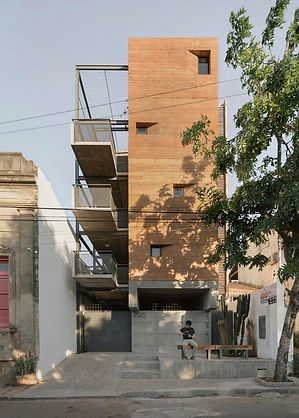
A multi-storey apartment building that rises in the Las Mercedes neighbourhood of Asunción —one of the more traditional residential areas of the city— the Valois building takes the rammed earth technique to a high-density urban context and introduces it as a very feasible possibility to contribute to the much-needed densification of cities, achieved by expanding upwards, instead of horizontally and without efficient urban sprawl regulations. A combination of the vernacular material with a reinforced concrete structure and metallic elements forms the rectangular volume, which is “designed as a central earth box that is punctured at specific points in the façade and withdrawn from the street as a gesture in the neighbourhood to allow for a space for public use” [21].
A truly revolutionary approach to the way in which the materiality of urban domestic spaces is thought about, the Valois proves that it is also possible to employ the rammed earth construction method away from and detached from the ground. The architect proposed it as part of a “search for relevant solutions in a time that requires a rethinking of what we architects do in cities” [22].
b) Cement-stabilised, poured ‘liquid’ earth buildings
LUCE Y PABLO HOUSE (2021) – Mínimo Común Arquitectura
Built in an ample lot in the city of Mariano Roque Alonso, in a suburban context and with the Paraguay river nearby, Luce y Pablo explores a variant of the traditional rammed earth that the architects called ‘poured earth’, which uses a much more liquid mix and was chosen after an exploration that determined that this technique would allow for a faster construction process, needing less human, technological and economic resources [23].
A trial-and-error process, including test tubes, allowed for the achievement of the desired stabilisation of the earthen mix that was to be poured in the frameworks, starting with 10% cement that was ultimately reduced to 5%, [24] thus enhancing the sustainability possibilities of the method.
In the house, the poured earth walls comprise mainly one of the two volumes: the one containing more private spaces for working and resting. Throughout, they are combined with more traditional materials like bricks, concrete, glass, and wood, making for a harmonious composition that shows the aesthetic possibilities that the material offers, in addition to the aforementioned advantages that allow for the saving of time and resources.
VIVIENDA DE TIERRA LÍQUIDA [25] (2020, cement and polymeric fibre [26] stabilised) –
Oficina de Arquitectura X
This house, built in the high-density urban setting of the city of Fernando de la Mora, shows the possibility of building in such a context, achieving narrower walls thanks to the poured earth method. In a lot that is only 6 meters wide, the technique allowed for 10-, 15- and 18- centimetres wide walls, [27] in stark contrast with the needs of rammed earth walls, which usually require a minimum width of 30 centimetres, proving its potential to be adapted to the usual compartmentalisation of urban land.
In the house, the boundary walls and the majority of the main walls are built with poured earth. In addition to showing the “scars” of the framework that once contained the liquid earth, the studio explores new textures and shapes achieved by varying the disposition of the framework. A pointy, angular set of tall prisms adorn the internal courtyard, and in the main façade, the poured earth wall of the upper floor is pierced by several small circles, contributing not only to the final aesthetic perception of the volume but also to the spatiality of the room on the other side, allowing for hundreds of rays of light to enter the space through the circles.
DESIGNING CITIES WITH EARTH IN PARAGUAY
The previous sections have demonstrated that villages made with rammed earth have existed in the world for a very long time, that there is a possibility for the tradition to spread through territory, and that the rammed earth construction culture is present in the explorations of contemporary architectural studios in Paraguay with the addition of the poured earth variant that can save time and resources, and that allows for thinner walls.
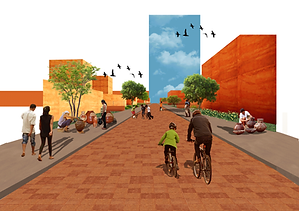
This section aims to offer a utopian glimpse of what a set of four blocks in a city in Paraguay would look like if buildings were entirely built with rammed earth and/or poured earth. It is worth noting that the development of the design of proposed typologies will be left for further, future research, with this paper focusing on the fact that the techniques are already a part of the architectural practices in the country, that the material is abundant, and that the benefits are environmental, social, economic, urban and political, offering an adequate alternative to current construction practices.
For this hypothesis, four blocks in the outskirts of the city of Tobatí will be reimagined, respecting the lot divisions established by the municipality, following a desire to show the applicability of the technologies into known urban structures. This city in the department of Cordillera is known for its long history of craftsmanship, ceramics, pottery, tiles, and the making of bricks. Its accessible and easily extracted clay soils are one of the reasons for the tradition, and many families have inherited the craft for generations, forming a collective and communal knowledge, making bricks and ceramics usually in their own yards. This set of costumes and traditions makes for an environment where self-made earthen homes and public buildings are feasible.
The proposal imagines three types of buildings, represented by simple volumes in images 7 through 9 in this stage of the research. Their shapes respond to the technological possibilities presented in Chapter 3, in regards to their function, height, geometry and lot occupation. First is a single-family home with a central yard in between two volumes, with a chance for the rear volume to grow in height to accommodate bigger families. Second, multi-family apartment buildings of up to three stories high, to keep a uniform height of buildings in the area. And lastly, public, communal buildings are proposed on up to two stories high if needed, standing out from the residential buildings because of their curved walls, intended to accommodate schools, universities, libraries, community centres, hospitals, government buildings and so on.
CONCLUSION
This essay first explored examples of rammed earth construction in vast areas of the same territory throughout history, showing examples in Morocco and China that display the versatility of scale possible with the technique, and its durability over time. Additionally, the example of the rammed earth tradition in Western Australia shows its contemporary applications, its adaptability to current regulations and the potential of the material to form an aesthetic identity for a region, and thus a sense of pride and community.
Chapter 3 explored five Paraguayan buildings; the first three were made with rammed earth: a day care centre, bathrooms with curved walls, and an apartment building; and the last two residential examples were made with poured earth. These cases show that there is interest in the earthen techniques in the region and their versatility of use. Its application to build curved walls and high story buildings, plus the achievement of narrower walls with the poured earth option, expands the possibilities.
Finally, chapter 4 takes the earthen technologies into an actual city in Paraguay, placing three types of buildings inside the existing plots of four blocks in the outskirts of Tobatí. This sums up the options provided by all of the case studies, international and local, in a place where the raw material is abundant. The proposal imagines the intervention with simple volumes, hoping that further investigations can emphasise the design and construction process of each typology.
Therefore, it is possible to affirm that earthen construction methods, including rammed and poured variants, can be used to think about the design of future cities in Paraguay. The examples presented show not only the aesthetic possibilities of a material that comes right out of the territory, but also a growing interest in the development and improvement of the techniques to offer a feasible alternative to the use of materials with harmful effects to the environment, and that feel out of place in Paraguayan urban landscapes.
To the undeniable ecological benefits shown by the material, tied to its thermal properties and its abundance, its social, urban and economic advantages further showcase its potential. Offering a chance for people to build their own buildings through the learning of an accessible construction technique, the very earth from the land represents a valuable political tool that allows for equal housing possibilities to all citizens, creating a strong sense of belonging to buildings and communities created by their very users “from the ground”.
With temperatures reaching peak heights every year, and with the lack of efficient governmental policies to regulate the effects of the construction industry on the environment, and to offer equal housing possibilities to the population, turning to the earth is a logical, necessary and most importantly, feasible possibility.
This article was peer-reviewed by Adi Bamberger and Kleovoulos Aristarchou
[1] Giada et al., 2019.
[2] Strazzeri and Karrech, 2023.
[3] Minke, 2006.
[4] Khtou et al., 2021.
[5] El Rharbi and Jarrad, 2014.
[6] ibid
[7] Stella Aligizaki, 2020.
[8] Stella Aligizaki, 2020.
[9] Strazzeri, (2022).
[10] Strazzeri, 2022.
[11] Strazzeri, 2022.
[12]Pekholtz, 2023. Translation by the author.
[13] Early Childhood Centre, in Spanish.
[14] Equipo de Arquitectura.
[15] Zuniga.
[16] Equipo de Arquitectura.
[17] Restrooms of the auditorium of the Faculty of Architecture, Design and Art – UNA, in Spanish.
[18] Meza.
[19] Coulleri, 2022a.
[20] Meza.
[21] Coulleri, 2022b.
[22] Interview by the author.
[23] Ott, 2022.
[24] Ott, 2022.
[25] Liquid Earth House, in Spanish.
[26] Meza.
[27] Coulleri, 2022c.
References
Aligizaki, Stella, ‘The settlement of refugees in Colafranceschi, E., Elisabetta Pallottino and Paola Porretta, ‘Tulou: the rammed earth dwellings of Fujian (China). Functional, typological and constructive features.’, The International Archives of the Photogrammetry, Remote Sensing and Spatial Information Sciences, Volume XLIV-M-A-2020, (2020) pp. 937-944.
El Rharbi, S. and F. Jarrad, ‘Earthen architecture & sustainable building: Proposed union between
authenticity and technical renovation - Case of south moroccan villages’, World SB14 Barcelona,
(2014), pp 493-499.
Interview between author and José Cubilla (Asunción, 4 March, 2022).
Khtou, Osmar, Issam Aalil and Mohamed Aboussaleh, ‘Characterization of Earthen Construction in South-Eastern Morocco’, Journal of Materials Science and Engineering, nr. 11, (2021), pp 114-119.
Minke, Gernot, Building with Earth: Design and Technology of a Sustainable Architecture. (Basel:
Birkhauser – Publishing for Architecture, 2006).
Strazzeri, Vittoria, Contemporary rammed earth construction in Western Australia. (The University of Western Australia – School of Engineering, 2022).
Online References
Chen, Lichao, Zhiyu Lan, Chaochao Wei, Dan Ouyang, Boren Shi, Peiyin Chen, Mingzhe Wang and Tianyi Xie, ‘Practice and Reflection on Rammed Earth Architecture: The Case Study of Tiles Hill–Xiangshan Campus Reception Centre in China.’, Buildings, nr. 14, (2024). https://doi.org/10.3390/buildings14124034 (accessed 16 April 2025).
Ciancio, Daniela and Christopher Beckett, ‘Rammed earth: an overview of a sustainable
construction material’ Conference paper. (2013) https://www.researchgate.net publication/243972161 (accessed 17 April 2025).
Coulleri, Agustina (curated by), ‘Complejo sanitario facultad de Arquitectura, Diseño y Arte /
Alberto Martinez + Guido Villalba + Yago García + tda’, ArchDaily. (07.03.2022) https://www.archdaily.cl/cl/977960/complejo-sanitario-facultad-de-arquitectura-diseno-y-artealberto-martinez-plus-guido-villalba-plus-yago-garcia-plus-tda (accessed 19 April 2025).
Coulleri, Agustina (curated by), ‘Edificio Valois / José Cubilla’, ArchDaily. (24.02.2022)
https://www.archdaily.cl/cl/977405/edificio-valois-jose-cubilla (accessed 19 April 2025).
Coulleri, Agustina (curated by), ‘Vivienda de tierra líquida / Oficina de arquitectura X’, ArchDaily.
(16.07.2022) https://www.archdaily.cl/cl/985497/vivienda-de-tierra-liquida-oficina-dearquitectura-x (accessed 20 April 2025).
Equipo de Arquitectura, ‘Centro de la primera infancia’, Equipo de Arquitectura.
https://equipodearquitectura.com/proyectos/centro-de-la-primera-infancia/ (accessed 19 April 2025).
Giada, Giuffrida, Rosa Caponetto and Francesco Nocera, ‘Hygrothermal Properties of Raw Earth
Materials: A Literature Review’, Sustainability, nr. 11, (2019) pp 1-21.
https://www.mdpi.com/2071-1050/11/19/5342 (accessed 17 April 2025).
Meza, Luca, ‘Sanitarios del Auditorio de la Facultad de Arquitectura, Diseño y Arte - UNA: proceso
de diseño y configuración’, Blog Gesto. https://www.amanecer.com.py/blog-gesto/blog/37
(accessed 19 April 2025).
Meza, Luca, ‘VIVIENDA VTL: La metáfora de la caverna’, Blog Gesto.
https://www.amanecer.com.py/blog-gesto/blog/47 (accessed 20 April 2025).
Ott, Clara (curated by), ‘Vivienda Luce y Pablo / Mínimo Común Arquitectura’, ArchDaily.
(02.05.2022) https://www.archdaily.cl/cl/981102/vivienda-luce-y-pablo-minimo-comunarquitectura (accessed 20 April 2025).
Pekholtz, Melina, ‘Escenas arquitectónicas de una contemporaneidad situada’, La Escuela.
(10.06.2023) https://laescuela.art/es/campus/library/mappings/escenas-arquitectonicas-de-unacontemporaneidad-situada-melina-pekholtz (accessed 18 April 2025).
Strazzeri, Vittoria and Ali Karrech, ‘Qualitative and quantitative study to assess the use of rammed
earth construction technology in Perth and the south-west of Western Australia’, Cleaner Materials, nr. 7, (2023), pp 1-17.
https://www.sciencedirect.com/science/article/pii/S2772397623000023?via%3Dihub (accessed 16 April 2025).
Zuniga, Jessica, ‘Equipo de Arquitectura Uses Biophilia for an Unexpected Classroom Design’, gb&d magazine. https://gbdmagazine.com/equipo-de-arquitectura/ (accessed 19 April 2025).
Martin Alvarez is an architect practising in Paraguay, where he works in a collective that focuses on housing and restoration projects, in addition to their research and consultancy on strategic planning for urban development. He also teaches Criticism of Architecture at the National University of Asunción, and edits and writes for an online blog / printed magazine about architecture, art and design.
Foundation of own collective practice Territorios Paralelos, 2020
Teacher, Criticism of Architecture, Universidad Nacional de Asunción, since 2023
Paraguayan architectural licence, 2020
MA Architectural History, The Bartlett, UCL 2018
BArch, Universidad Nacional de Asunción, Facultad de Arquitectura, Diseño y Arte, UNA, 2017

Published in Issue 2026
Will Spring be far?
Explore other articles in this issue: