
In State
of Becoming
Re-imagining material narratives through a culture of care
by Ania Chorzępa and Prarthana Murali
Architecture, historically associated with permanence and monumentality, has evolved in response to rapid industrialization. In today’s world, this notion of ‘permanence’ has manifested itself in monumental landfill deposits, driven by a building culture that places speed and convenience at its forefront. The resulting architecture has become hazardous to both its inhabitants and its surroundings. In addition, there is a perceptible disconnect between users, architects, and the material world. Working towards nurturing the relationship between the ‘living matter’ of buildings and the ‘living environment’ that includes both human and non-human inhabitants, this research advocates the need for holistic material literacy for designers through a re-imagined design process. By combining technical expertise with emotional and cultural narratives of materiality, this work aims to engage designers more comprehensively with materials and provoke a dialogue on material sensibilities. At its essence, this research seeks to reintroduce a culture of care and connection in both building and inhabiting, along with encouraging a focus on the continually changing states of material becoming to support ecological transition.
[Image 1] ‘In state of becoming’ material wheel (sample).
Image by the authors (2023).
MATERIAL NARRATIVES
A narrative, in essence, is a practice of communication through storytelling, reflecting a particular perspective and set of values. Material narratives can be defined as the stories embedded in materials that describe their source, use, as well as their physical, environmental and cultural implications. These narratives could also show how practices and systems have shaped them over time, through different experiences and varied cultural and historical perceptions.
From the Vitruvian attributes for architecture of ‘firmitas’, ‘utilitas’, and ‘venustas’, translated as ‘strength’, ‘utility’, and ‘beauty’, buildings in ancient Greece and Rome became a conscious symbol of durability, mainly with the use of stone, representing fictional values of ‘cultural superiority’. Often these principles were used against the more vulnerable materials, though carefully crafted and maintained, they were disregarded as ‘primitive’. As earth building artist and researcher Becky Little and architect Tom Morton observe, carved stones, despite dominating historic records, convey the experiences of a select few of those in power. However, clay (especially unfired clay) has a more inclusive and broadly relevant experience to share, despite being given a low-status. “This cultural and conservation bias is partly why earthen materials in buildings are less valued than stone materials.” [1]
The industrial revolution then led to building materials like concrete and steel monopolising the market, underlining the appeal of permanence in architecture. Chosen mainly for their speed of construction, they have inadvertently created negative environmental impacts from their high carbon emissions and manifested in a practice supporting the accelerated evolution of landfills. Additionally, the speed of development, cost-saving measures which reduce material quality, and little focus on futureproofing design, means buildings are now often demolished after a very short life. In contrast to a true ‘lifecycle’ when materials are reused or decompose naturally, modern construction follows a ‘cradle-to-grave’ model with highly processed and industrial materials, mirroring a finite ‘lifespan’ rather than a regenerative cycle. [2] This linear market practice of ‘take-make-dispose’ [3] has led to the construction industry accounting for more than 30% of the waste in landfills. [4]
”The ready availability of cheap oil-based materials has led to the emergence of a new material logic which rejects the porous, breathing building technologies we lived with for centuries. The hermetically sealed environments we make using what comes down to a set of variations on plastic sheeting are (...) all oil-derived and created through energy -intensive, polluting processes.’’ [5]
These materials have also become so complex that developing a thorough understanding of their sourcing, production, and performance has become increasingly challenging. Any interaction with them has been reduced to selection and procurement off the shelves, as static artifacts. As a result, inhabitants are alienated from the materials that envelop them and are generally disconnected from any conscious acts of care for them. The act of maintaining a building, its materials and components is typically performed by specialised consultants.
In contrast, biologically and geologically based materials like wood, clay, earth, bamboo, to name a few, welcome user participation in the life-cycle of materials and the slower rituals of care. Buildings made with regenerative materials hold a significant value to the user with their accessibility of maintenance and care. Engaging in a regenerative building process is not only easier, but also more enjoyable and healthier for the inhabitants. This skill transfer ensures a longevity of materials’ lives, as they are repaired, altered and reused to suit the changing needs of the inhabitants. As earth architect, Anna Heringer, described the construction process of her METI school: “The choice of earth as building material also made it possible to include a lot of participants in the process: in addition to the kids, we had people that were elderly, and some with disabilities on the site. These inclusive qualities of building with mud is, to me, one of its greatest qualities.” [6] Nonetheless, this form of building practice is often disregarded, in some contexts, due to the higher initial cost as well as the required change in our existing construction systems and lifestyle practices.
TECHNICAL & EMOTIONAL TOOLS FOR MATERIAL LITERACY
Technical Process Tools
In response to the current climate and ecological crisis, along with many practitioners working towards ecological transition [7], there is a growing resource of manuals, manifestos, lectures and workshops to equip architects with the tools and knowledge needed for a nuanced building practice. This is supported by several technical tools and systems prioritizing circular economy like Buildings as Material Banks (BAMB). It is a vital system providing comprehensive data on harvesting building materials and components with the help of Material Passports (MP) and Building Information Modeling (BIM). These tools help practitioners to effectively manage the sourcing, repair, reuse, rebuild and disassembly of buildings and their components. While this system requires longer initial planning, it fosters practices like material leasing, reusable fittings, adaptable spaces, and designs that offer ease of maintenance and extend the building’s lifespan. [8] By understanding the economic incentive of this approach, architects can advocate for it in the early stages of the project and educate investors and clients about how BIM-integrated design can help ensure long-term resale value of their materials.
The Environmental Protection Encouragement Agency (EPEA) distinguishes circular processes into biological cycles where materials can return to nature, supporting ecosystems and technological cycles where materials are designed for reuse within industrial systems – effectively “mining the Anthropocene” [9][10][11]; this distinction is crucial for a transition to a fully regenerative process.
There is growing interest and support for bio-based materials, with many designers experimenting with new materials and challenging conventional practices. The archive of the Future Materials Bank is a valuable resource platform that collects new material experiments, assessing their potential and impact based on usability, environmental sustainability, social sustainability, and afterlife of the material. The main challenge a lot of these new materials face is upscaling, as the current system does not support their promotion and they struggle to grow from small scale ‘kitchen experiments’ into a full scale production.
Emotional process tools
While a part of our approach delves deep into understanding the technical aspects of materials, and their potential for circularity in the built environment, we will explore the emotional values present in matter, which have potential in evolving the user-spatial relationship. These values flow from indigenous or cultural stories, history, everyday memories of space, intuitive connections and many other situational relations we have with the material universe. In a world that is increasingly growing displaced and disconnected from these intangible values, our objective is to explore a design process that brings out and highlights these inherently deep connections. They have significant potential in advocating for materials supporting holistic sustainable practice.
In ‘The Riddle of Humanity’ [12], Rudolf Steiner postulates a philosophy of interconnectedness between the fixed and dynamic aspects of nature. Linking it to the twelve human senses (the sense of touch, life, movement, balance, smell, taste, sight, warmth, hearing, word, thought, ego) and the seven bodily processes (breathing, warming, nourishing, individualizing, maintaining, growing, and reproducing). Exploring the complexities of humans’ relationship with the material world can help designers create spaces that resonate with the inhabitants’ mindscape. The sense of ego allows us to empathize with matter, and could empower designers and users to recognize materials as collaborators with their own ‘self of self’ to relate to. To develop a process that supports these relationships, we further analysed systems that could consider material specification collaboratively with the users and designers.
The ladder of inference is a mental model conceived by Chris Argyris (1970) of the way the human brain unconsciously travels from facts to taking action and arriving at decisions, and also how cognitive bias affects our decision making. While challenging the status quo and advocating for a new process, architects and designers often face a wall of resistance due to fear, biases or ingrained belief systems. Acknowledging these barriers, we recognized the need for a process that addresses these assumptions and encourages users to rethink and reconsider their views of materials.
Seetal Solanki’s Ma-tt-er Material Atlas [13] is an intuitive platform that invites and encourages people to form a deeper connection to the material world. It focuses on four different categories of materials such as native, local, migrant and cosmic. Rather than viewing the collected materials as mere resources to extract, it emphasizes their potential for developing meaningful interpersonal relationships with the place.
These precedent instruments contributed to our understanding of requirements for tools for a holistic design process, which ask pertinent questions and encourage open dialogue while being interactive and engaging.
THE 'IN STATE OF BECOMING' TOOLKIT
“There is not much about sharing space with other life, about building and living modestly, about the need to design spaces and places that restore and repair rather than destroy and deplete. As we tell this story of profound interconnectedness we will need better and more effective methods of storytelling in an era of text messaging and short attention spans. The mystery and magic of nature will need to be part of the answer.” [14]
Following the preliminary study of the collected existing architectural design systems supporting cradle to cradle material lifecycles, we propose to integrate emotional values that are currently absent from these systems. This integration could aid in better understanding and humanising materials for a more holistic systems thinking. By connecting users to the material changes through their memories, and atmospheric associations formed since childhood, this emotional connection could also help designers overcome one of the struggles in advocating for natural materials: the concern about maintenance and frequent care for a less durable matter. Phineas Harper, architecture critic and maker, argues for caring for the building in his writing on degrowth [15]: “To actively embrace maintenance, rather than avoid it, would mean a radical change in the material culture of construction. We should embrace thatch, adobe hemp, lime and other plant-based materials with vigour, not in spite of their need for frequent maintenance, but because of it.’’ [16] In the age which celebrates ‘zero maintenance’ architecture, our contention is to reintroduce the purpose and beauty in periodic maintenance practices or rituals. These practices play an important role in sustaining a meaningful user-spatial connection.
To bring this perception of buildings to the forefront, we put forward a prototype of a digital toolkit supporting new material narratives and a design process embracing ecological transition. These tools can be educational for designers and users, championing their material literacy and focusing on re-establishing a culture of care for the built environment.
We began with a revised material design process for reuse or return to earth. This life cycle of matter is visualised in a graphical wheel to display key considerations starting from the birth of a material. These continue through understanding the sourcing, manufacturing or fabrication, assembly, and the material’s use up to its death (composting) or disassembly for another life-cycle. This ‘in state of becoming’ material wheel [Image 1] is supported by a glossary of interpretations for the terms mentioned, which could be periodically reviewed and rewritten. Based on the considerations mapped in the material wheel, we developed a material journey in the format of a flowchart to guide architects and designers in better understanding their material choices, and to make mindful decisions. This process begins at the design stage when as much as 80% of a product/building’s impact is determined [17] and takes the designer on a complete journey from its source to death or reuse.
The ‘in state of becoming’ material journey [Image 2] begins with identifying the material as either virgin, composite, reclaimed or biologically and geologically based. Then, the questions follow the technical parameters laid out according to the ‘in state of becoming’ material wheel, from birth to death. The questions trace an impact of materials’ sourcing, examining for example, whether it supports the local economy, the effect of its extraction on biodiversity, or the resources required for its production and the by-products from it. This inquiry flows from technical to more cultural properties- asking, for instance, whether this material application is vernacular, or if the required understanding or skills are inclusive for different bodily abilities, as well as whether there is any potential in future development of this material technique or application. The interview continues through the next stages of the material’s life looking closely at its use and maintenance, whether it is harmful to human and non-human health or whether this material supports indigenous craftsmanship, as well as if it is adaptive to changing climatic conditions. At the end of the material’s life, there are further prompts exploring if there is a positive market value for the reused material or if it requires any further processing to be reclaimed. These are just a few examples of how the process encourages a comprehensive, thoughtful approach to material selection.
Conducting a detailed material enquiry is, understandably, time consuming. Therefore, we identified a need for collecting and consolidating this
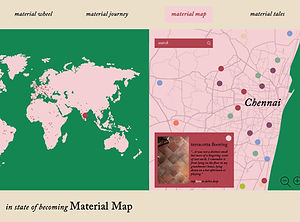
material data and creating an open resource of materials supporting ecological transition. It is critical to understand where these materials come from and what bioregions they occupy, so that designers, makers, users etc can easily find natural or reclaimed materials in close proximity to their site. An ‘in state of becoming’ material map [Image 3] has been created, where one can browse through ecologically viable matter, which has already arrived at the end of our detailed flowchart interview. When a new material is added to the map, further data is collected and analysed, continuing the ongoing evolution of this resource. This is enhanced with the ‘in state of becoming’ material tales which focus on the emotional data, asking users to share their very personal journey with the matter. This begins with gathering information on physical properties of the substance, how it changes over time and what effect these changes have had on the user. It then continues the inquiry with collecting stories and memories, as well as encouraging users to share their personal experiences in daily or periodic rituals associated with the material, including the caring and repairing of the materials. Users will also be able to add any further experiences and also contribute any visual representation or references to craftspeople and specialists who can advise and help with the material application, maintenance and repairs.
The complete digital toolkit will be available as a web-based application, though the prompts within them aim to provoke more physical engagement. The toolkit serves as a starting point, but for designers to be able to responsibly create buildings that are ecologically sensitive and emotionally resonant, physical connection is pertinent in their material literacy.
CRAFT, CARE AND CONNECTION WITH THE MATERIAL WORLD
A shift towards a culture of care for our material world requires designers and makers to consider, from the beginning of the material specification, the weathering, use, wear as well as decay and eventual death of their projects. Beyond developing a deep understanding of the physical aspects of the materials, the role of an architect extends to that of a caretaker who engages earnestly with the material’s web of embedded stories, history, as well as its connections to the communities tied to it. This building culture can result in an architecture that is inherently mutable, adapting to the evolving needs of its occupants, environment, and the materials themselves.
As the building is constructed and transitioned to its inhabitants, this role of the caretaker extends from the architect to those who inhabit it. A building, in its entirety, is never truly ‘complete’; it continues to evolve and transform throughout its lifespan, shaped by the rituals of care and use. Moreover, the material world is not merely a collection of static artefacts but dynamic objects capable of transformations over time, shaped by their environment. As Kate Yeh Chiu and Jia Yi Gu assert, “Even after a building is complete, the materials found within it embody potential for alteration, continuing an unending cycle of change. This recognition of materials as ongoing processes—rather than as raw resources or finished products—centers human actors and systems in the event of material transformation, reminding us that materials are not inert objects, but active agents.” [18]
Every act of care for materials is a dialogue with them, offering opportunities to develop a more meaningful and enjoyable kinship with the material world. This practice of cultivating a culture of care within and for the built environment is not a new concept but a practice that is deeply rooted in different indigenous cultures around the world. Yunkaporta [19] illuminates the indigenous ways of living, thinking, knowing and interacting with the land, and how these relationships are nurtured through intergenerational practices of care. He also highlights that the practices are not rooted in ownership of land and resources but are about stewardship, responsibility and reciprocity. Understanding the nuances and applying these relational thinking patterns in architecture and design can help transform the relationship between people and their environment. Another compelling example of this care and connection is the ‘Lippan Kaam’ [20] practiced by the indigenous communities of Kutch in Gujarat, India. Rendered with clay, dung and mirrors, this practice began as a simple act of brightening the walls. It also cooled the homes during the harsh summers, and acted as a form of storytelling through the clay motifs, reflecting the communities’ ties to their land and culture. The periodic act of care and maintenance is more than ornamentation but an heirloom, passed down through generations, rooted in memory and meaning.
Periodic acts of care and maintenance, facilitated through a transfer of skills to inhabitants, or when necessary, through skilled craftspeople, help in user’s autonomy in nurturing materials and forging strong connections with artisanal communities. This intangible nature of skill transfer not only empowers and provides agency to these communities, but has the potential to regenerate and revitalize long-forgotten cultural practices and knowledge systems. Ultimately, embracing this culture of care can help reframe the conventional approach to architecture and the material world, nurturing a more ecologically sensitive future.
A WAY FORWARD
“(...) we need to find ways to inhabit change rather than deny or deflect it, and to find meaning in transition, transience, and uncertainty. If one accepts that we live in a world of ecological unraveling and rising seas, fragile economies and gathering storm clouds, then one is forced to admit that we may not be in control anymore, if we ever were.” [21]
In the current era of climate emergency, the journey towards an ecological building practice through holistic material literacy provides a constructive course to a more sustainable built environment. The proposed ‘in state of becoming’ toolkit serves as a catalyst to encourage deeper engagement with the material world on both individual and cultural levels, rooted in the emotional vernacular of the context. To support this shift, there need to be several broader and actionable steps taken, in every context.
Firstly, significant administrative and policy-level changes are crucial to embed these practices in the statutory construction and design processes. Regulatory bodies must not only incentivize the use of regenerative materials. They must support practices that prioritize material reuse and promote circular economy principles, but also scrutinize any unnecessary use of high-carbon materials. Beyond policy level support, it will be key for architects to facilitate the sharing of knowledge and creating ecosystems of support where – together with designers, builders and inhabitants – they can work towards nurturing local materials and their life cycles. This encourages the revival of traditional craftsmanship, ensuring the sustenance of valuable skills and know-how.
Integration of these schools of thought in architectural pedagogy is also an essential facet. Equipping students with tools for holistic material literacy can help them better understand both the ecological and emotional significance of the materials they work with, starting with making more conscious choices when selecting material for their model making. In addition, learning to view materials as dynamic collaborators, instead of components of construction at an educational stage, will result in profound shifts in future architectural practices.
When holistic material literacy becomes the core principle in design and construction, buildings and spaces have the potential to become more adaptable, regenerative and in tune with the natural world. Understanding the continually changing states of material becoming could ultimately lead to a future that is ecologically driven, and deeply rooted in care and connection.
[1] Little and Morton (2024).



[2] Wilton (2023).
[3] Ellen McArthur Foundation, (2012).
[4] Ruiz, Ramón, and Domingo, (2020).
[5] Material Cultures (2022), p.74.
[6] Heringer (2024).
[7] By ecological transition, we refer to a positive shift in building practices to one that considers and works meaningfully with nature and ecology.
[8] Baker-Brown (2017).
[9] “Mining the Anthropocene” Baker-Brown, D. (2017) refers to the practice of repurposing materials from existing infrastructure instead of extracting new raw materials from the earth. The Anthropocene Epoch is an unofficial unit of geologic time, used to describe the most recent period in Earth’s history when human activity started to have a significant impact on the planet’s climate and ecosystems. Brown, T. (2023) National Geographic Society.
[10] Baker-Brown (2017).
[11] Braungart and McDonough (2002).
[12] Steiner (1916).
[13] Ma-tt-er Material Atlas (2018).
[14] Roös (2020), p.VIII.
[15] “Degrowth signifies, first and foremost, a critique of growth. It calls for the decolonization of public debate from the idiom of economism and for the abolishment of economic growth as a social objective. Beyond that, degrowth signifies also a desired direction, one in which societies will use fewer natural resources and will organize and live differently than today.”
D’Alisa, Demaria and Kallis (2015).
[16] Harper (2019).
[17] Elliott and Gowler (2021).
[18] Chiu, Gu and e-flux Architecture (2024).
[19] Yunkaporta (2019).
[20] Lippan kaam or Chittar kaam is a traditional mural craft of Kutch.The indigenous communities live in circular mud houses known as Bhungas with thatched roofs, evolved to survive the harsh weather conditions. The inner walls of the homes are adorned with decorative mud-mirror work to brighten their homes using motifs of animals, birds, their community life and also geometric patterns.
Sabnani (Accessed 15 June 2025).
[Image 2] ‘in state of becoming’ material journey (sample).
Image by the authors (2023).
[Image 3] ‘in state of becoming’ Material map (sample).
Image by the authors (2025).
This article is based on a thesis project conducted in 2023 by supervision of Elisa Engel with the Master of Advanced Studies in Architecture at BASEhabitat, University of Arts in Linz.
This article was peer-reviewed by Kıvılcım Göksu Toprak and Sophie Schrattenecker.
References
Baker-Brown, Duncan, The Re-Use Atlas: A Designer’s Guide towards a Circular economy (London: RIBA Publishing, 2017).
DBpedia, Biological life cycle (n.d.). https://dbpedia.org/page/Biological_life_cycle#:~:text=In%20biology%2C%20a%20biological%20life,returning%20to%20the%20starting%20state (accessed 10 May 2023).
D’Alisa, Giacomo, Federico Demaria and Giorgos Kallis (eds.), Degrowth: A Vocabulary for a new era (NewYork and London: Routledge, 2015).
DeSilvey, Caitlin, Curated Decay: Heritage Beyond Saving (Minneapolis: University of Minnesota Press, 2017).
DiCrescenzo, Jacob., ‘Architecture is a deeply emotional experience’, Common Edge (2021).https://commonedge.org/architecture-is-a-deeply-emotional-experience/ (accessed 27 June 2023).
Ellen McArthur Foundation, Towards Circular Economy: Economic and business rationale for an accelerated transition (Ellen MacArthur Foundation, 2012).
Gallant, Martine Josée, Body-Mind-Spirit: Emotional Feasibility of the Ruined. Masters of Architecture (Carleton University, 2013).
Handa, Rumiko, Allure of the Incomplete, Imperfect and Impermanent: Designing and appreciating architecture as nature (New York: Routledge, 2015).
Harper, Phineas, The Architecture of Emergency climate summit: The Architecture of Maintenance. The Architecture Foundation (2020). https://youtu.be/15sGPu-58UY?si=kH2SHQ1hUzBOekMl (Accessed: 07 March 2023).
Heringer, Anna, Form Follows Love (Basel: Birkhäuser, 2024).
Little, Becky and Morton, Tom, Earthbound Orkney. People, place, time and soil (Cupar: Arc Architects Ltd., 2024).
Material Cultures, Material Reform: Building for a post-carbon future (London: MACK, 2022).
McDonough, William and Braungart, Michael, Cradle to Cradle: Remaking the Way We Make Things (New York: North Point Press, 2002).
Orms, Material Passports (2021).
Röos, Phillip B., Regenerative-Adaptive Design for Sustainable Development: A Pattern Language Approach (Cham: Springer, 2021).
Ruiz, Luis Alberto López, Ramón, Xavier Roca and Domingo, Santiago Gassó, ‘The circular economy in the construction and demolition waste sector – A review and an integrative model approach’, Journal of Cleaner Production, vol. 248 (2020).
Sabnani, Nina, Lippan Kaam - Kutch: Traditional Mural Craft. Design Resource (n.d.). https://www.dsource.in/resource/lippan-kaam-kutch (accessed 15 June 2025).
Senge, Peter, The fifth discipline: The art and practice of the learning organization (London: Doubleday/Currency, 1990).
Solanki, Seetal, ‘Ma-tt-er’s Material Mapping Guide’, Material Atlas, https://materialatlas.world/ (accessed 07 March 2023).
Steiner, Rudolf, ‘The Riddle of Humanity’ (1916). https://rsarchive.org/Lectures/RiddHuman/19160812p01.html (accessed 18 April 2023).
Ukeles, Mierle Laderman, ‘Care: Manifesto on Maintenance Art’, Theories and Documents of Contemporary Art, pp. 622-624 (1969).
Wilton, Oliver, ‘Stories about Sustainability - Material Provenance’, AA School of Architecture (2022). https://www.youtube.com/watch?v=q8UKJSeQsiU (Accessed: 1 March 2023).
Yeh Chiu, Kate. Yi Gu, Jia and e-flux Architecture, ‘Material Acts’, e-flux Architecture. http://e-flux.com/architecture/material-acts/638213/editorial/ (Accessed: 4 December 2024).
Yunkaporta, Tyson, Sand talk: how indigenous thinking can save the world (Melbourne: The Text Publishing Company, 2019).
Ania Chorzępa is an architectural designer, builder and teacher with a deep focus on natural materials, particularly earth and fibre. Now based in Germany and balancing her work with motherhood, Ania’s practice centres on building with earth, teaching hands-on workshops and material research.
Earth Builder at Lehmbau Gaerter, Wasserburg am Inn, Germany
Master of Advanced Studies in Architecture - BASEhabitat, University of Arts, Linz, 2023
Master of Architecture - De Montfort University, Leicester, 2016
Bachelor of Architecture - De Montfort University, Leicester, 2014
Prarthana Murali is an architectural designer from Chennai, India, currently based in Munich, Germany. Through her studio work, hands-on material explorations and research, her core focus has been on building a practice rooted in ecological sensitivity and social responsibility while engaging with the parallels between architecture and indigenous history, heritage and archaeology.
Master of Advanced Studies in Architecture - BASEhabitat, University of Arts, Linz, 2023
Registered Architect, Council of Architecture, India, 2015
Bachelor of Architecture, SRM Institute of Science & Technology, Chennai, 2015
